Two custom ties can carry the same logo and cost twice as different amounts, wear differently, and take different weeks to arrive, all because of one decision made before a single thread is cut: whether the design is woven into the cloth or printed onto it. That single fork drives the detail you can show, the minimum you have to order, and the feel in the hand. Here is how the two methods actually differ, and how to match one to the job.
Woven ties build the design into the cloth
A jacquard woven tie is not decorated so much as constructed. The pattern lives in the weave itself, formed as warp and weft threads cross according to a programmed design, so the logo becomes part of the fabric structure rather than a layer sitting on top. Run a finger across a good woven tie and you can feel the motif in slight relief. Because the color comes from dyed threads, a woven design is limited to the discrete thread colors loaded on the loom and cannot produce smooth gradients or photographic shading. What it does superbly is crisp, repeating structure: stripes, geometric micro-patterns, small dots, and clean corporate or club logos. The color is locked into the yarn, so a woven tie holds its look through repeated wear and cleaning better than any printed equivalent.
Printed ties put the artwork on top
A printed tie starts as finished cloth, usually silk twill, that receives the design through digital inkjet using reactive inks, much like printing on paper but tuned for fabric. The payoff is chromatic freedom: CMYK process printing gives you a practically unlimited palette, continuous gradients, and the fine detail needed for illustrations or photographic artwork that a loom simply cannot render. The surface stays smooth and uniform rather than textured. Printing also wins on flexibility for short and varied runs; a single production run can carry dozens of design variants without a meaningful time penalty, which suits limited editions, event-specific ties, or a family of related departmental designs. The trade is longevity under hard use: quality prints hold color well, but a woven tie keeps its appearance longer with frequent washing. Whichever route you take, ask for a proof before the full run: a digital strike-off for a printed tie, or an actual woven header sample for a jacquard design, so you catch a color or scale problem on one piece rather than across the whole order.
Silk, microfiber, and the feel in the hand
Material is a separate axis from method, and it decides drape as much as decoration does. Silk remains the benchmark for hand feel and the way a tie falls and knots, and it takes both weaving and printing beautifully. Microfiber and recycled polyester sit below silk on drape but earn their place: they hit tighter budgets, stand up to daily institutional wear, and serve sustainability goals when recycled content matters to the buyer. For a school or company that issues hundreds of ties a year to be worn hard, a well-made microfiber tie is often the sensible call; for an executive gift or a flagship club tie, silk is worth the premium. Underneath the shell, the interlining does the invisible work. A wool or wool-blend interlining gives a tie body and, crucially, shape recovery, so the blade springs back rather than staying creased after the knot comes out.
Dimensions and the details buyers forget to specify
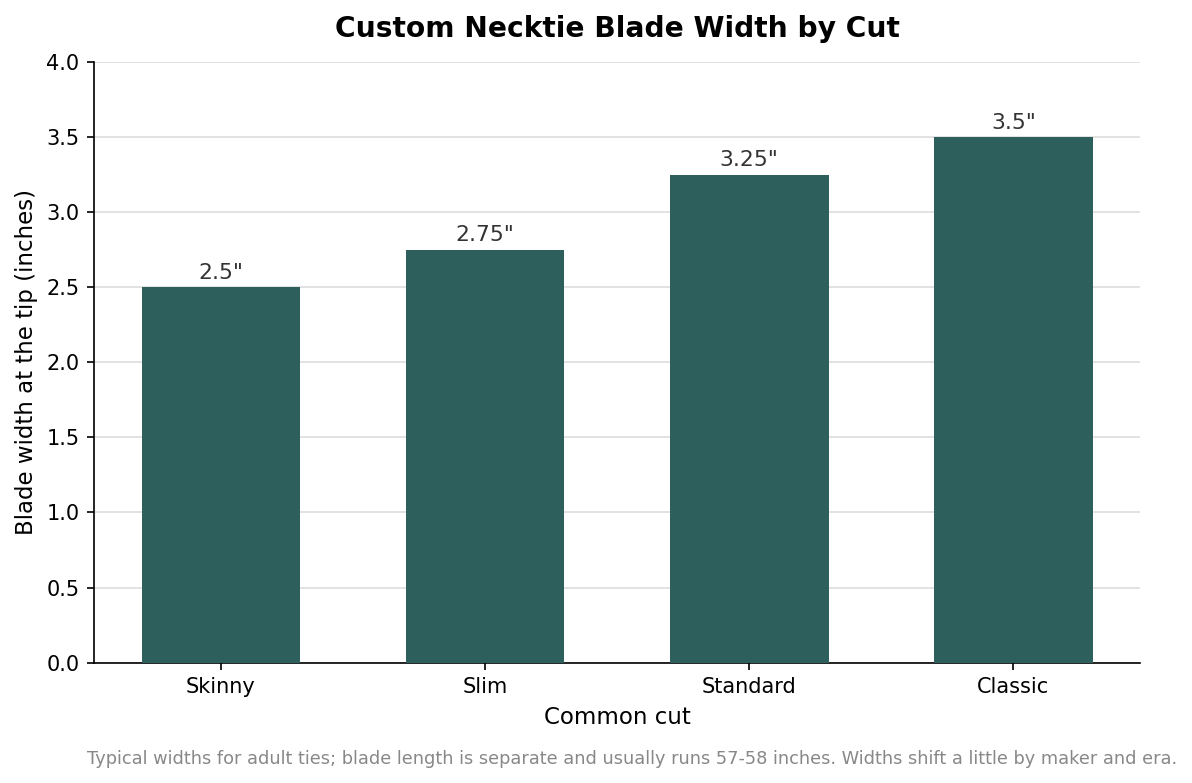
Getting the decoration right means little if the proportions are wrong. Adult ties generally run 57 to 58 inches in length, with blade width the main style lever: roughly 3.25 to 3.5 inches for a standard-to-classic cut, stepping down to about 2.75 for slim and 2.5 for skinny. Width should track the wearer’s build and the jacket lapel rather than fashion alone, since a tie badly out of proportion with the lapel reads as off even when nobody can say why. Reasonable manufacturing tolerances are tight, on the order of 1 to 2 millimeters on width and 5 to 10 millimeters on length, so hold your supplier to them. It is also worth specifying the tipping and keeper loop, the interlining weight, and whether you want a matching or contrasting back, because these are the small choices that separate a tie that looks bespoke from one that looks merely printed.
Minimums, lead time, and matching method to the job
Order quantity is where the two methods diverge commercially. At Get Custom Ties the minimum is 12 ties per design for either method, with lower per-tie pricing as quantities grow. Woven production carries a higher setup because the loom program has to be built, which is why weaving rewards larger runs with a better cost per piece, while printing has a leaner setup and stays economical on smaller, more varied orders. Factor the sampling round into the schedule too, since approving a physical strike-off adds a short loop up front that is far cheaper than reprinting a rejected run. Build the calendar backward from the date you need ties in hand. Get Custom Ties sends a free mockup within 24 hours and standard production ships in about 2 weeks after approval, with faster turnaround available through express shipping, so work back from your date and approve artwork early. Put simply: choose weaving for durable logos and structured patterns at volume, choose printing for detailed or photographic art and short varied runs, pick silk or microfiber to match budget and wear, and approve your mockup early enough that the about-2-week production window never becomes the reason your ties miss the event.